
|
BREAKING
INTO SHOWBIZ
Breaking into the music business obviously requires talent; a passion for and knowledge of music, singing, and performing; a high level of preparation; and realistic expectations and the ability to cope with rejection. As an attorney in the entertainment industry specializing in music, the advice and information that I will offer in this article is the same advice that I give to clients on a regular basis. Assuming that you have all of the above characteristics, the most common question is: "How do I get started?" The balance of this article will give pragmatic and useful information that should help provide direction for your start in the music business. Get
to Know the Business It is easy to learn about the music business. Take any related classes in high school or college. If no classes are offered, go to the music business section of your library or bookstore and you will find numerous books that are specifically written for people who are interested in learning about the business of music. I hope the message in this section is clear: always prepare to the extent of your ability. You can never know too much or over-prepare. Consequently, you must read, ask questions, and learn everything you can. If you do not learn about your business, you will benefit neither your short-term nor long-term career goals.
Get
Smart About Demo Packages As you may know, the music business today is being challenged by a number of factors, such as digital downloading and piracy. In this difficult environment, it is very easy for a record label to say "no" to a prospective new artist; therefore, an artist needs to be smart when creating a demo. Do not give the label any opportunities to say "no." Consequently, the general rule is that the demo should include only three songs, and these should be your very best vocal performances and your very best songs. If the label likes two or three of the songs you have a great probability of continuing the negotiations with the label. However, if you give the label 10 songs and they like only two or three, the other side of the equation is that the label does not like seven or eight of the songs. In this event, you will have lost your opportunity with that label. There are other very important matters that an artist needs to consider with respect to the demo. The first issue is the budget available to the artist for the production of the demo. You absolutely do not need to produce a demo that is ready to be played on the radio. I have obtained recording contracts for artists whose demos are merely a voice and a piano or a voice and a guitar. Do not be fooled by a producer who wants a high fee because he believes the demo must be "radio ready." Remember that a singer/songwriter's demo is not a producer's demo. The purpose of the demo is to get a contract for the artist, not the producer. The people reviewing the demo are listening only to your voice and the quality of your songwriting. You must also remember to leave money in your budget necessary for "shopping" the demo. Get
Help, Then Follow Through Your demo package should contain a terrific photograph. A headshot is good, but it should be accompanied by a full-body shot as well. You also may include a biography or discography, if it contains good and impressive industry information, such as any prior recordings, concert experience, industry awards, and honors.
Finally, do not include any cover songs on the demo. No matter
how talented you are, the person listening to the demo will always
compare you to the singer and the recording that made the song famous.
Inevitably, you will come up second best and give the label another
opportunity to say "no." When putting the demo package
together, always remember: the goal is to get the record label to
say "yes!" Home
I
Subscribe I Advertising I Classifieds
I Pageantry
Mall I Links I Our
Writers I Back
Issues |
 David
Bercuson is a Miami attorney specializing in the music
and television industries. He has represented artists, record labels,
producers, music publishers, composers, managers, on-air television
talent, and independent television producers in the negotiation
and re-negotiation of significant industry agreements. He has handled
the business and legal affairs for several independent record companies,
popular recording artists, and television personalities. Mr. Bercuson
is also a specialist in licensing music and finding deals for artists.
David
Bercuson is a Miami attorney specializing in the music
and television industries. He has represented artists, record labels,
producers, music publishers, composers, managers, on-air television
talent, and independent television producers in the negotiation
and re-negotiation of significant industry agreements. He has handled
the business and legal affairs for several independent record companies,
popular recording artists, and television personalities. Mr. Bercuson
is also a specialist in licensing music and finding deals for artists.
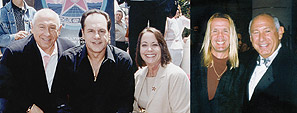 Rock
of Ages — David
Bercuson has handled the business of major music acts, including
Harry Wayne Casey, who is "KC" of KC & The Sunshine
Band (Far Left: with David's wife, Marla Bercuson) and (Left)
Nicko McBrain of the musical group Iron Maiden.
Rock
of Ages — David
Bercuson has handled the business of major music acts, including
Harry Wayne Casey, who is "KC" of KC & The Sunshine
Band (Far Left: with David's wife, Marla Bercuson) and (Left)
Nicko McBrain of the musical group Iron Maiden.